Friday, July 22, 2011

Should I buy a new graphics card?

I entered into a "more detailed than necessary" examination of this. The basic questions are:
  • What will it cost?
  • What sort of improvement to performance can I expect (can I play Shogun 2)?
  • Will any power savings pay for some new card?
Given my current rig is a pair of nVidia 8800 GT (2 x 512MB) in an SLI config; and Shogun 2 reports graphics requirements as "AMD Radeon HD 5000 and 6000 series graphics cards or equivalent" (pcgamer.com), I had no idea. I went looking for benchmarks, and couldn't find everything (my old/current  rig, and some equivalent to the Radeons) on the same page.

I compiled some stats from previous years, did some (very) rough math and came up with this worksheet:
GPU decision worksheet. It turns out that my pair of 8800GT offers identical performance to a (more) modern GeForce GTX 460 (1GB RAM), which offers sufficient performance to play Shogun 2.

The upshot of this? I can play Shogun 2 on my current rig, and it's very unlikely that I can recover the cost of the new GPU through power savings. No new kit for me :-(

Monday, June 20, 2011

How to build a (modern) Windows Server

http://jeremywaldrop.wordpress.com/2008/10/28/how-to-build-a-windows-2008-vmware-esx-vm-template/

Excellent. I think some of the decisions are little odd (turn off the firewall?!?), but this covers a lot of ground.

Tuesday, February 08, 2011

The cloud - public, private, and the appliances within

I talked to a sales guy the other day, one of the better ones. Not only was he forthcoming, helpful, and charming, he was knowledgable and experienced; a rare breed. I had been out of this vendor's loop for a bit and asked what was going on; he mentioned all kinds of things he thought I'd be interested in, including a big cloud push for the vendor's software. Great. I segued into software appliances and he told me they were dead. Not limping, not re-purposed - DEAD.

From a techie's point of view (which is, to be fair, not the same as a salesman's) I see these as points along a continuum, or at least pre-requisite. "The Cloud" is all about ecomomies of scale, and industrialisation of information technology. In order to achieve the desired outcomes from The Cloud, standardisation and mechanisation are pre-requisites. A software applicance is a standardised "unit" (when properly built), an abstraction of an underlying mechanisation, it's the thing you want in The Cloud.

Amazon knows this, rPath knows this, VMware knows this, and Google has been doing this implicitly (as have all big web shops) since its inception; but the commentariat seem to have completely missed it, the analysts have missed it, and most of the vendors have missed it. It's a joke.

The Cloud is only a cloud while the hard bits are hidden. When the hard bits start peeking out, The Cloud becomes The Mess. When the hard bits get hidden, you're running someone else's software, on someone else's hardware (or your own - pick a public or private cloud as suits you), and we all become a lot more happier with the result.

The Cloud == Appliances.

Thursday, February 03, 2011

TIBCO fiddles

In brief:
  1. When fiddling with TIBCO Software, use an OpenSUSE virtual machine, it hurts less.
  2. Oracle XE is very handy for fiddling with TIBCO software - Here's a great web page explaining how to set it up on OpenSUSE - http://forums.opensuse.org/install-boot-login/414654-how-install-oraclexe-opensuse-11-1-a.html
  3. Give your VM about 2GB RAM, or more.
  4. Create a different Unix user for each 'build' (ActiveMatrix v2 suite, ActiveMatrix v3 suite, BusinessWorks/Administrator suite, etc.). Don't let them read/write to each other's files, ever.
  5. Do not install gcj, OpenJDK, or anything remotely like Java and not made by Sun and/or Oracle.

Wednesday, January 05, 2011

Further Time Machine-esque behaviour

My earlier post on Time Machine-esque backups ( http://lastinfinitetentacle.blogspot.com/2009/06/backups-for-lazy.html )  has some useful links for getting regular differential backups going. However, it can be done more neatly, particularly when it come to Windows, and I've come across a nifty solution here http://www.robgolding.com/blog/2009/01/14/leveraging-vss-and-robocopy-for-robust-backups/

This approach requires the vshadow.exe application, which is its own can of worms. Typically, vshadow ships with a/the Windows SDK - ServerFault has some info ( http://serverfault.com/questions/137126/vss-error-521-when-attempting-backup/137254#137254 ) which suggests getting the Vista era SDK (v6.1, from http://www.microsoft.com/downloads/details.aspx?FamilyID=e6e1c3df-a74f-4207-8586-711ebe331cdc&displaylang=en ). You will only need to install the "Win32 Developer Tools" component; you can ignore everything else.

Using VSS (Volume Shadow Service) will allow an internally-consistent copy to be made of a Windows drive. All I then need to do is port the script here ( http://serverfault.com/questions/27397/sync-lvm-snapshots-to-backup-server/168034#168034 ) to Windows. I could use the script to push the image onto the file server, where it can update SVN repository (a physical backup, for bare metal recovery). Handling the (Windows) shadow drive can be achieved using the Windows-native 'dd' from http://www.gmgsystemsinc.com/fau/ . The same dd tool can be used for an 'easy' recovery. If I get this right, it should be Windows native, and easy to install/maintain.

A separate job will pick out user directories for the Time Machine treatment (more of a logical backup, also on my file server, for basic file recovery) via the mercifully short script I previously linked to, thus: http://blog.interlinked.org/tutorials/rsync_time_machine.html

Technically, I could use Zumastor/ddsnap on the file server to get snapshots/revisions, and I still might...

Monday, November 22, 2010

MDX for the hard of thinking

That includes me. Between Mondrian's exciting behaviour (at least that of the schema editor) and the vagaries of MDX, I'm finding this OLAP stuff hard to get into. This is a nice rundown on what MDX is. I'm still hoping there's a nifty Mondrian intro I haven't found yet.  http://www.databasejournal.com/features/mssql/article.php/10894_1495511_6/MDX-at-First-Glance-Introduction-to-SQL-Server-MDX-Essentials.htm

Monday, October 11, 2010

Movements in the IT world

First shots fired in cyber-war
The security consulting business isn't going anywhere. It's interesting to note that an attack that requires a state-level actor is now a very real possibility in the near term. I remember when you'd have been laughed out of the room for such a suggestion.
http://www.theregister.co.uk/2010/10/09/stuxnet_enisa_response/

IT industry consolidation means the first patent-war is on
The first shots have long since gone quiet. It's like the GFC of intellectual property.
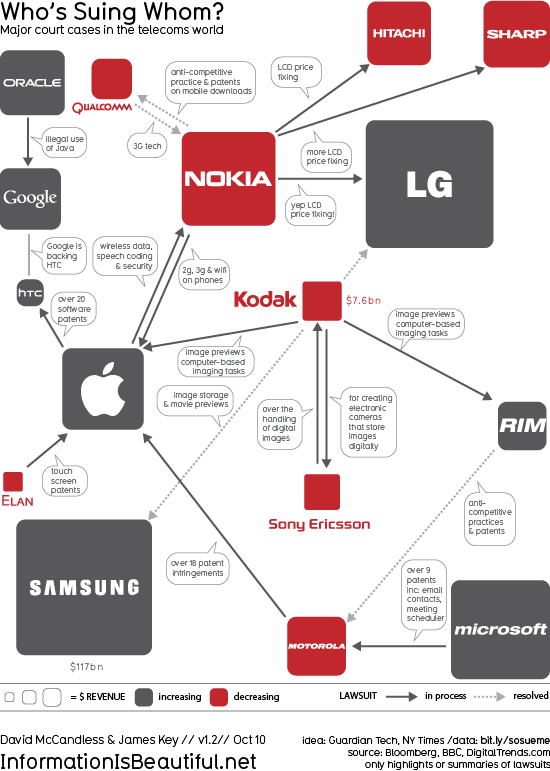
See this diagram for the current state of mobile-phone/IT/consumer electronics.
http://infobeautiful2.s3.amazonaws.com/whos_suing_whom.png

Anyone got some hard data on the consolidation of the IT industry? The merger between consumer technology and IT industries? By revenue? There's rich picking for somone to do the numbers, and make a pretty picture.

Wednesday, June 30, 2010

Virtualisation and Service Oriented Architecture

I was reading over at the TIBCOmmunity site regarding the impact of virtualisation on architecture
( http://www.tibcommunity.com/blogs/soa-architecture/2009/07/24/virtualization-and-its-affect-on-architecture ). There's some handy information here, but it feels a bit lost under a heading of "SOA architecture"; so I thought I'd have a go, under the heading of "I think...".

Virtualisation is the capability to encapsulate arbitrarily complex environments (by adding yet another layer of abstraction, naturally). Virtualisation is a means of utilising commodity hardware in ways that were previously the preserve of esoteric, expensive, proprietary systems.

What does this mean in the context of SOA?

I think the eventual result is that services can/will be built as software appliances. The moves around OSGi are heading in this direction, allowing a more 'focussed' environment to be built. I'll expand on my view of a software appliance life cycle in a later post.

I do believe that the eventual goal around a SOA (at a technical level) should be something like an AMI virtual machine (the lingua franca of the cloud), with defined "production", and management,  services. This could/should be hosted in some cloud (public/private), or combination of clouds. The services/VMs may depend on other defined services (provided in a SaaS, or other, manner). Some overarching management environment will be required to manage the relationships between services (and I believe that this is where VMware is heading, fast).

Tuesday, June 23, 2009

Wednesday, October 15, 2008

Gold!

A readable, recent blog on big JVM heaps... They're bad, naughty, offer rubbish performance, but they're hard to dodge.

http://andrigoss.blogspot.com/2008/02/jvm-performance-tuning.html

Certainly, it's better than this effort from Tangosol/Coherence/Oracle ("Use our product!"). As it happens, I need to sort this for a badly built product based on Coherence... Oh! The pain!