Monday, October 11, 2010

Movements in the IT world

First shots fired in cyber-war
The security consulting business isn't going anywhere. It's interesting to note that an attack that requires a state-level actor is now a very real possibility in the near term. I remember when you'd have been laughed out of the room for such a suggestion.
http://www.theregister.co.uk/2010/10/09/stuxnet_enisa_response/

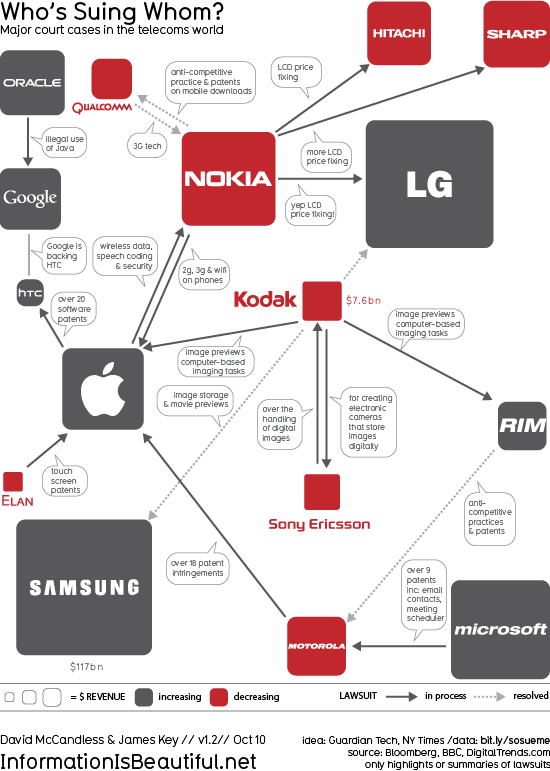
IT industry consolidation means the first patent-war is on
The first shots have long since gone quiet. It's like the GFC of intellectual property.
See this diagram for the current state of mobile-phone/IT/consumer electronics.
http://infobeautiful2.s3.amazonaws.com/whos_suing_whom.png

Anyone got some hard data on the consolidation of the IT industry? The merger between consumer technology and IT industries? By revenue? There's rich picking for somone to do the numbers, and make a pretty picture.

Wednesday, June 30, 2010

Virtualisation and Service Oriented Architecture

I was reading over at the TIBCOmmunity site regarding the impact of virtualisation on architecture
( http://www.tibcommunity.com/blogs/soa-architecture/2009/07/24/virtualization-and-its-affect-on-architecture ). There's some handy information here, but it feels a bit lost under a heading of "SOA architecture"; so I thought I'd have a go, under the heading of "I think...".

Virtualisation is the capability to encapsulate arbitrarily complex environments (by adding yet another layer of abstraction, naturally). Virtualisation is a means of utilising commodity hardware in ways that were previously the preserve of esoteric, expensive, proprietary systems.

What does this mean in the context of SOA?

I think the eventual result is that services can/will be built as software appliances. The moves around OSGi are heading in this direction, allowing a more 'focussed' environment to be built. I'll expand on my view of a software appliance life cycle in a later post.

I do believe that the eventual goal around a SOA (at a technical level) should be something like an AMI virtual machine (the lingua franca of the cloud), with defined "production", and management,  services. This could/should be hosted in some cloud (public/private), or combination of clouds. The services/VMs may depend on other defined services (provided in a SaaS, or other, manner). Some overarching management environment will be required to manage the relationships between services (and I believe that this is where VMware is heading, fast).

Tuesday, June 23, 2009

Wednesday, October 15, 2008

Gold!

A readable, recent blog on big JVM heaps... They're bad, naughty, offer rubbish performance, but they're hard to dodge.

http://andrigoss.blogspot.com/2008/02/jvm-performance-tuning.html

Certainly, it's better than this effort from Tangosol/Coherence/Oracle ("Use our product!"). As it happens, I need to sort this for a badly built product based on Coherence... Oh! The pain!

Friday, June 06, 2008

Vista and VMWare network irritation

I've been working with VMWare a bit recently, on my machines. As both the machines I use are relatively new, they came with Vista. Vista has been irritating, but less so than a downgrade.

Vista wants to describe and categorize all the network interfaces. Unfortunately, that includes the virtual network adapters that VMWare sets up (and probably the same for Windows qemu users fiddling with openvpn for its TAP implementation); and it gets its knickers in a twist because they don't seem to lead anywhere. The solution for Vista (pre-SP1) was to take advantage of a bug and add bogus default gateways to the virtual interfaces. The solution for Vista SP1 is more involved, but at least seems more "proper".

Essentially, you need to hack the Windows registry and tell Vista that these interfaces aren't leading anywhere. This seems a bit odd, as there may be an extensive network infrastructure of VMs; but that's it.

Use the registry editor of your choice and follow this:
http://communities.vmware.com/message/916766#916766

Wednesday, April 30, 2008

Perl Best Practices, live!

Whack your dodgey Perl code in here and get the the bad news right away!

Thursday, April 24, 2008

Quick product review

I got a new laptop recently, an M1330 from Dell. I'd thought I throw out a few quick comments on the process.

Up to the minute technology says that the Penryn family of processors are excellent for laptops, with The Register suggesting that, alone, they can increase battery life significantly. In terms of graphics, the world of little laptops revolves around Intel's X3100 or nVidia's 8400M. The M1330 can have either - I went for the nVidia option as I like playing games now and again.

That left a choice of screen. I plumped for the more expensive OLED option after The Register's review. I noted that Dell seems to have responded to the review by raising the price of this option. RAM - 4GB (I could have saved £50 and blown my warranty by adding this myself, but out of £1000, why?). Hard disk - 250GB (it's enough for me).

The laptop runs nicely. Vista's a dog, but it's Vista. The graphics performance is better than I expected (TF2 runs well, except for the water effects). And the number crunching power is all I'd hoped for.

I tried Ubuntu 7.10 for a bit, and it ran well, but I hit issues with wireless networking and my home network, so restored Vista. I may try again once the new release settles back down. I have no love for Vista.

In a nutshell:
Dell M1330 8/10 - Solid.
Microsoft Vista 3/10 - Soft.

Friday, April 18, 2008

USB dead device fix

I have a slug (NSLU2) at home, serving out a big USB hard disk. I like my slug. It's small, and it runs Debian, and so long as I remember that it's really small, it runs really well.

It looks like USB drives suffer from lots of issues with dodgey firmware and drivers. Certainly, I haven't escaped them. Every few months I lose the USB drive:
kern.log:
Apr 12 20:32:54 slug kernel: scsi 1:0:0:0: rejecting I/O to dead device

...

This can cause filesystem corruption as well, and is generally "A Bad Thing". Fixing this issue is (for me) a case of remounting the filesystem. I recall once I also had to cycle the power too. Fortunately, I found this page: http://www.mail-archive.com/linux-usb-users@lists.sourceforge.net/msg16510.html which has a very nifty technique for coaxing the USB stack back to life.

I've written a script to pull out the sysfs name of the USB device for a given mount point. At some point I'll add this in to my slug so that it "just works". That just leaves a log scraper to pick up each mount and get the sysfs name, wait for a failure, unmount the dead file system, rebind the USB device, check the file system for damage, and remount the filesystem. Easy!
#!/bin/bash
# get_usb_name.sh
# e.g.: ./get_usb_name.sh /media/usb2

USB_DEV=$(mount | grep ${1} | cut -f 1 -d ' ' | sed -e 's/[0-9]$//' -e 's(^/dev/((')
USB_ADDR=$(ls -l /sys/block/${USB_DEV}/device | sed -e 's(/host.*$((' -e 's(^.*/((')
if [ -e /sys/bus/usb/drivers/usb-storage/${USB_ADDR} ]
then
echo $USB_ADDR
else
echo "could not verify usb address of ${USB_ADDR} for device ${USB_DEV}" >&2
fi

Sunday, March 09, 2008

Throw-away coding

I tinker with things a lot. There's an explosion of tiny projects that I've tried out once, and never really want to look back at, so this tip on how to have a project without saving it in VC++ is very welcome.

Coming to Eclipse? Already there? I can't find it if it is.

Personally, I always keep a scratch.txt on my desktop/home directory for keeping code snippets for re-use/reminders. Having a system that supports brief testing/fiddling is a great nod to the way (a lot of) people work.

Wednesday, February 20, 2008

Devolo not-so-bad

My suspicions about the devolo kit being on the slow side have turned out to be partly true, but they were really the least of my problems. I took an hour or two to revive an ancient laptop (from when MMX instructions were something to brag about) to test different points around the network, configurations, etc. As old as the laptop is, it's quite capable of doing a few things, and it's reliable.

What I couldn't figure out was why my new PC was only able to move things over the LAN at 0.3Mb/s! It's almost modem type of speeds. Because of the way my flat is laid out it was awkward to isolate the new machine and find out the exact cause. I (literally) dusted off an ancient laptop, and pressd it into service.

After continuously rewiring most of my flat and retesting, it became clear that my new PC, all on it's lonesome, was the cause of the glacial network throughput. After some web searches, auto-scaling on vista was pointed at - no luck (didn't think so, there weren't routers in this path).
More web searches suggested NAM wasn't good. It took awhile longer to discover that NAM is Nvidia's "Network Access Manager", and it's rubbish. I uninstalled it.

Without the devolo kit or NAM in the loop, network throughput jumped up towards the expected speeds (100Mb/s). I've put the devolo kit back into it's original places, and it's not too quick - ~11Mb/s; but my best option right now (and thirty times faster than NAM was forcing me into).

During testing I found that the devolo kit, when installed in sensible places (no power strips, etc.) will get close to it's theoretical speeds. Happy days - if you have power sockets free in the right places. I'll make do.